

Guide
Dating safety: the complete guide
Stay safe dating online: protect your profile, spot romance scams, plan safe first dates, and find verified helplines in your country.
Updated · 12 min read · By the getme team
$1.14bn
Why safety deserves its own guide
Most dates are uneventful in the best way: a coffee, a chat, maybe a second date. But dating means meeting strangers, and a small number of people use dating sites to scam, pressure or harm others. Knowing the common risks and a few habits makes a real difference, and it lets you relax and enjoy the good parts.
The financial side alone is serious. The US Federal Trade Commission reported that consumers lost $1.14 billion to romance scams in 2023, with a median reported loss of $2,000, and that these were the costliest kind of imposter scam reported to it. Similar patterns are reported by regulators in Australia, the UK, Canada and across Europe. Romance scams aren't limited to dating apps, but apps are one of the places they start.
This guide covers what to do before you meet, on the date and afterwards; how to spot scams and manipulation; how to protect your privacy; and where to get help in your country. It's written for adults of all genders and sexualities. If you're reading this because something has already happened, skip to getting help.
Before you match: set up your profile safely
Safety starts with what you share publicly.
- Use your first name only. Your surname makes it easy to find your social media, workplace and address.
- Don't show your exact location. Avoid photos in front of your home, your car's number plate, your workplace logo or your kids' school uniform. getme only ever shows your neighbourhood, never your address, and distance is rounded.
- Keep your social handles off your profile, at least until you've met someone and trust them.
- Use photos that aren't on your other public accounts. A reverse image search can link a dating photo to your Instagram or LinkedIn.
- Verify your profile. Selfie verification proves you're the person in your photos, and it helps others trust you. On getme, the badge only appears after a real person reviews the check.
- Choose who can message you. On getme, strangers can only send a single message request, and you can turn requests off entirely.
While chatting: what to share and what to watch for
Keep conversations on the app until you've met. Apps have reporting tools and moderation; your phone number and personal email don't. If someone pushes hard to move to WhatsApp, Telegram or another platform straight away, treat it as a warning sign.
Things you don't need to share early on:
- Your full name, home address or exact workplace.
- Your daily routine (when you run, which gym you go to).
- Financial details of any kind.
- Intimate photos. Once sent, you can't control where they go. If you're ever threatened with the release of intimate images (sometimes called sextortion), don't pay; stop contact, keep evidence and report it.
Red flags in conversation
None of these alone proves someone is dangerous, but each deserves attention, and several together are a strong signal:
- Pressure. They push you to meet somewhere private, move faster than you want, or keep asking after you've said no.
- Love-bombing. Intense affection very early: "I've never felt like this", "you're my soulmate" after a few days.
- Inconsistencies. Their story about job, location or age changes, or their photos don't match how they write.
- Avoiding video or meeting. Weeks of chatting with excuses every time a call or meeting is suggested.
- Hostility when you set a boundary. How someone reacts to "no" tells you a lot.
- Requests for money, gift cards, crypto or help moving money. Always a red flag. See the next section.
How romance scams work
Romance scammers are often organised and patient. They aren't usually after a date; they want money, and they're good at building trust first. Common patterns include:
- The overseas professional. They say they're working on an oil rig, in the military, as a doctor with an aid agency, or as an engineer on a contract abroad. It explains why they can't meet or video call.
- The emergency. After weeks of daily contact, there's a crisis: a medical bill, a customs fee, a frozen bank account, a ticket to come and see you. They ask for money "just this once".
- The investment opportunity. They talk about how well they're doing with crypto or trading and offer to help you invest. The platform shows big gains, until you try to withdraw. This is sometimes called "pig butchering".
- The parcel or money mule. They ask you to receive a package or money and send it on. This can involve you in crime without you realising.
Common threads: a reason they can't meet, a growing emotional bond, then a request involving money or moving money. Never send money, gift cards, crypto or bank details to someone you haven't met in person, however genuine they seem. If you're unsure, talk to a friend you trust; scammers rely on secrecy.
If you think you've been scammed
- Stop all contact and don't send anything more.
- Contact your bank immediately. Some transfers can be stopped or recovered if you act quickly.
- Keep evidence: screenshots, usernames, transaction records.
- Report the profile on the app so it can be removed.
- Report to the national scam authority in your country (see below).
- Be wary of "recovery" services that contact you offering to get your money back for a fee. Many are scams too.
Being scammed is not a sign that you're foolish. Scammers are skilled, and they target people of every age and background.
Before the first date
- Video call first if you'd like extra reassurance. It confirms someone is who their photos say, and it's a good test of chemistry.
- Do a light check. Search their first name and city, or reverse-image-search a photo. You're not looking for their life story, just checking they're real.
- Choose the venue yourself or agree on a busy public place you know. A café, a bar early in the evening, a market or a popular park during the day.
- Tell a friend who you're meeting, where, and when, and share the profile. Agree a time to check in. Many phones let you share your live location temporarily.
- Plan your own way there and back. Don't accept a lift from someone you've just met, and don't share your address.
- Charge your phone and make sure you have money for a ride home.
On the date
- Stay in public for the first meeting. If they suggest going back to their place or somewhere isolated, you can say no.
- Watch your drink. Keep it with you, and if you leave it, get a new one. If you suddenly feel much more drunk than you should, tell staff and a friend immediately.
- Trust your instincts. If you feel uncomfortable, you can leave. You don't need a reason. "I'm going to head off, take care" is enough.
- Have an exit plan. Some people arrange for a friend to call at a set time. Many venues are happy to help if you ask staff discreetly.
- Respect boundaries both ways. Consent can be withdrawn at any time, and it can't be given by someone who is very drunk. Clear, enthusiastic agreement matters.
After the date
- Let your friend know you're home.
- If you'd like to see them again, say so. If not, a short, kind message is enough.
- If they won't take no for an answer, block them. On getme, blocking hides you from them everywhere in the app.
- If anything happened that worries you, report it on the app and, if a crime may have occurred, to the police. You can report even if you're unsure.
Protecting your privacy and data
Your safety includes your digital footprint.
- Use strong, unique passwords and turn on two-factor sign-in where offered.
- Be careful with links. Scammers send fake "verification" links to steal logins. getme will never ask you to verify through a link in a chat.
- Check app permissions. Location, contacts and photos should only be shared when needed.
- Know your rights. Depending on where you live, privacy laws such as the Australian Privacy Act, the UK GDPR, the EU GDPR, Canada's PIPEDA or US state laws give you rights to see, correct and delete your data. Each of our country pages lists the regulator you can complain to, for example Ireland or Germany.
Safety for LGBTQ+ daters
Everything above applies, plus a few specific points. In some places, people still face harassment or entrapment through dating apps. Take extra care with what you share before meeting, and be cautious about meeting someone who refuses any verification. If you're travelling, check local laws and conditions. Many LGBTQ+ organisations offer support lines; your country safety page links to general helplines that can refer you on.
Harassment and abuse
Harassment includes unwanted sexual messages or images, repeated contact after you've said no, threats, and hateful abuse. It's never your fault and you don't have to put up with it.
- Block and report. On getme you can report any profile, message, photo, post or listing. Reports go to a human team that reviews them against the Community Guidelines.
- Keep evidence before blocking, in case you want to go to the police.
- Tell someone. A friend, family member or helpline.
If you're in an abusive relationship that started online, specialist domestic violence services can help with safety planning, even if you're not ready to leave. The numbers are on your country page.
Getting help in your country
If you are in immediate danger, call your local emergency number. Then use these pages for verified, free helplines, how to report scams, and how to complain about privacy:
- Australia: Safety Centre (000, 1800RESPECT, Lifeline 13 11 14, Scamwatch)
- United Kingdom: Safety Centre (999, Samaritans 116 123, National Domestic Abuse Helpline 0808 2000 247, Action Fraud)
- United States: US safety & privacy (911, 988, National Domestic Violence Hotline)
- Canada: Canada safety & privacy (911, 9-8-8, Canadian Anti-Fraud Centre)
- Ireland: Ireland safety & privacy
- Germany, France, Spain, Italy, Netherlands, Belgium, Austria, Switzerland, Portugal, Poland, Sweden, Norway, Denmark, Finland: see each country page, for example Spain, Netherlands and Sweden.
- Anywhere else: Find A Helpline lists free support services by country.
Dating while travelling or new in town
Dating in a city you don't know well adds a few extra risks, simply because you have fewer people to call and less sense of which areas and venues are comfortable.
- Pick venues near where you're staying and close to busy streets or public transport.
- Save local emergency numbers in your phone when you arrive. In the EU and many other countries, 112 works from any mobile.
- Share your plans with a friend at home, including the venue name and the person's profile.
- Keep your passport and most of your cards at your accommodation rather than on you.
- Be wary of anyone who insists you visit a particular bar and then leaves you with a large bill. Some tourist areas have known scams of this kind.
If you've just moved somewhere, our moving to a new city guide has more on finding your feet socially and safely.
Sex, consent and sexual health
If a date goes well, you may want to take things further, now or later. A few principles keep everyone safer:
- Consent is ongoing. Agreeing to one thing doesn't mean agreeing to everything, and anyone can change their mind at any point.
- Alcohol and drugs affect consent. Someone who is very drunk or high can't consent. If in doubt, wait.
- Talk about protection before it becomes urgent. It's a normal, adult conversation.
- Get tested regularly if you have new partners. Sexual health clinics are free or low-cost in many countries and are confidential.
If you've been sexually assaulted, it's not your fault. You can get medical help, emotional support and, if you choose, report to the police. Specialist services are listed on your country's safety page.
How to help a friend
Sometimes it's easier to see warning signs from the outside. If a friend is dating online:
- Offer to be their check-in person for first dates.
- Ask about money gently if they mention a partner they've never met who has problems or opportunities involving cash. Scammers often tell victims to keep the relationship secret; a friend's calm questions can break that spell.
- Don't shame them. People who feel judged stop talking, and that helps the scammer or abuser.
- Know where to point them: the app's report button, their bank, and the helplines on their country page.
How getme helps keep you safe
We don't think safety should be a paid extra. Here's what's built in for everyone:
- 18+ only, with date of birth checks at sign-up and reports of under-18 users acted on quickly.
- Selfie verification reviewed by people, with a badge that only appears when it's done.
- Message requests: strangers get one message, and you choose whether to reply. You can turn requests off.
- Block and report everywhere: profiles, chats, photos, posts and listings.
- Rounded distance and no addresses: we store a neighbourhood centre point, never your exact location.
- Human moderation of reports, and an admin team that can remove accounts.
- Clear Community Guidelines and Terms, including rules against paid sexual services and scams.
A one-page safety checklist
- Profile: first name only, no location clues, verified.
- Chat: stay on the app, no money, no intimate photos, watch for pressure.
- Before: video call, light check, public venue, tell a friend, own transport.
- During: stay public, mind your drink, leave whenever you want.
- After: check in, block if needed, report anything worrying.
Frequently asked questions
Should I video call before meeting?
It's a good idea, especially if you've been chatting for a while. It confirms someone is real and helps you decide whether you want to meet. Someone who repeatedly refuses is a warning sign.
What if I feel unsafe during a date?
Leave. Ask venue staff for help if you need it, call a friend, or call the emergency number if you're in danger. You never need a reason to end a date.
Someone asked me for money. What should I do?
Don't send it. Stop contact, report the profile, and if you've already sent money, contact your bank straight away and report it to your national scam authority.
Can I report someone after I've unmatched?
Yes. You can report from your chat history or by contacting support. Include as much detail as you can.
Does getme share my location?
No. Other members see an approximate distance and your neighbourhood. We store a neighbourhood centre point, never your exact location or address.
Where can I find helplines for my country?
Each country has a safety page with verified numbers, for example the US, Canada and Ireland. Australia and the UK are covered in our Safety Centre.
Is it rude to ask for a video call before meeting?
Not at all. Many people do it, and most genuine matches are happy to. Frame it positively: "I'd love to chat properly before we meet, are you free for a quick video call this week?" How someone responds is useful information either way.
What should I tell my friend before a date?
The person's first name and profile, a screenshot of their photos, the venue and address, the time you're meeting, and when you expect to check in. Agree what your friend should do if they don't hear from you by then, such as calling you and, if needed, the venue.
Related pages
More guides
Use this stat
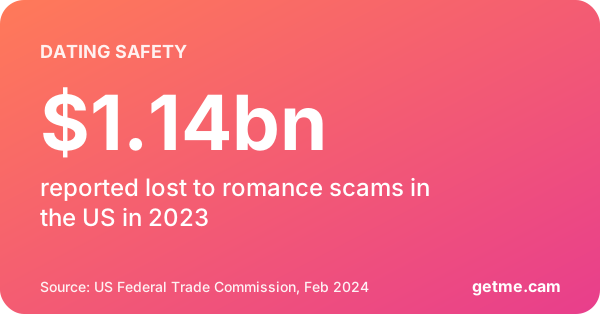
Source: US Federal Trade Commission, Feb 2024. Free to embed with the credit link.