

Guide
Buying and selling safely on classifieds
Inspect before you pay, avoid overpayment and rental scams, meet safely for collections, and what to do if you’re scammed.
Updated · 12 min read · By the getme team
$432m
Why classifieds still matter, and why safety matters
Local classifieds (online noticeboards for buying, selling, renting rooms, finding events and returning lost property) are one of the most useful parts of the internet. They keep good things out of landfill, help people find affordable furniture, cars and rooms, and connect neighbours. They also attract scammers, because money changes hands between strangers.
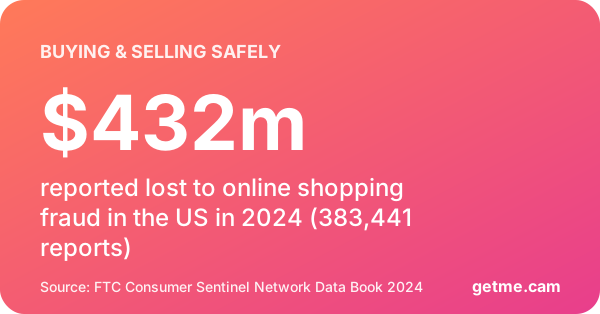
The scale is significant. The US Federal Trade Commission's Consumer Sentinel Network Data Book for 2024 listed online shopping and negative reviews as the second most reported fraud category, with 383,441 reports and $432 million in reported losses. Not all of that comes from classifieds, but marketplace-style scams make up a large share of what people report.
This guide covers how to buy and sell safely, how to rent a room without getting scammed, how to meet strangers for collections, how to spot fake listings and payment tricks, and what to do if something goes wrong. It applies to getme classifieds and to any other local marketplace.
The golden rules
If you remember nothing else:
- Inspect before you pay. See the item, the car or the room in person, or via a live video call you control.
- Pay on collection using a traceable method, or cash in a safe place.
- Never pay deposits to hold items or rooms you haven't seen, especially to someone who says they're overseas.
- Never accept overpayments or refund the difference.
- Keep communication on the platform until you're sure.
- Meet in busy public places in daylight where possible.
- Trust your instincts. If it feels wrong, walk away.
Spotting a fake listing in 60 seconds
A quick routine catches most fake listings before you waste time:
- Price check. Is it well below similar items nearby?
- Photo check. Do the photos look like stock images, or appear elsewhere in a reverse image search?
- Profile check. Is the account brand new, unverified, or listing lots of high-value items at once?
- Story check. Is there a reason they can't meet, or an urgent deadline?
- Payment check. Do they want a deposit, gift cards, crypto or an unusual transfer method?
Two or more yes answers is enough to walk away and report the listing.
Buying safely
Before you contact the seller
- Check the price. If it's far below similar items, ask why. Very low prices are the most common lure.
- Read the description carefully. Vague descriptions, copied text and stock photos are warning signs.
- Look at the seller's profile. How long have they been a member? Do they have other listings? Are they verified?
- Reverse-image-search the photos. Scammers often use pictures from other listings or shop websites.
When you message
- Ask specific questions about condition, age, reason for selling, and whether you can see it working.
- Ask for a new photo with today's date or a specific detail. Genuine sellers can do this easily.
- Be wary of stories that explain why they can't meet: working overseas, in the military, moved away, a relative is selling for them.
- Don't click links to "payment portals" or "delivery services" sent by the seller.
At the viewing
- Inspect everything. Test electronics, check serial numbers, try on clothes, open drawers, look for damage.
- For cars, check registration and ownership documents, look up any finance owing or theft records using your country's official checks, and consider an independent inspection.
- For phones and laptops, check they're not locked to an account or reported stolen, and that the seller can factory-reset them in front of you.
- For high-value items, ask for proof of purchase.
Paying
- Pay when you collect, not before.
- Use traceable methods: bank transfer at the time of collection, or card where the seller accepts it. Cash is fine for small amounts, in a safe place.
- Don't pay by gift cards, crypto or money transfer services to people you don't know.
- Be cautious with "buyer protection" claims in emails or messages; check them on the platform's own site.
Buying a used car privately
Cars are the most expensive thing many people buy through classifieds, so they deserve extra care.
- Check the vehicle history using your country's official or reputable checks: whether there's finance owing, whether it's been written off or reported stolen, and its registration status. In Australia, the PPSR search covers finance and write-offs; in the UK, check the MOT history on GOV.UK and consider a private history check; in the US and Canada, vehicle history reports and the VIN help.
- Match the VIN (vehicle identification number) on the car to the documents.
- Meet at the seller's registered address where possible, and see the car in daylight.
- Test drive on different roads, with the seller present and your licence and insurance in order.
- Get an independent inspection from a mechanic, especially for older or high-value cars.
- Pay securely. Bank transfer at handover, with a written receipt that includes the VIN, price, date and both parties' details. Avoid carrying large amounts of cash.
- Complete the transfer paperwork the same day, as your local road authority requires.
Electronics and phones
Phones, laptops, consoles and cameras are popular, and so are scams involving them.
- Check the serial number or IMEI where your country offers a stolen-device check.
- Make sure the device is unlocked from the previous owner's account and can be factory reset in front of you.
- Test it properly: screen, buttons, cameras, charging, speakers, connections.
- Be wary of "sealed" new devices at big discounts. Counterfeits and empty boxes are common.
- Keep the receipt or a written note of sale.
Children's items and recalls
Second-hand prams, car seats, cots and toys can be great value, but safety standards matter.
- Check product recalls on your country's product safety website before buying or selling.
- Car seats should meet current standards, be within their expiry date, and never have been in a crash. Many safety organisations advise against buying used car seats unless you know their history.
- Cots and sleep products should meet current safety standards; avoid modified or broken items.
- Toys should have no small loose parts for young children and no damaged batteries.
Tickets and vouchers
Event tickets and gift vouchers are popular scam items because they're easy to fake and hard to verify.
- Buy from official resale platforms where they exist.
- Never pay by bank transfer to a stranger for tickets you can't verify.
- Check the event's resale rules. Some tickets are tied to the original buyer's name.
- Be suspicious of "last-minute" sellers with heavily discounted tickets to sold-out events.
Selling safely
Creating your listing
- Use your own photos, clear and honest, showing any flaws.
- Describe the item accurately, including condition, size and reason for selling.
- Set a fair price. Check similar listings.
- Don't include personal details in the listing: no phone number, address or email.
- Use a template. getme classifieds have templates for items, rooms, notices, events and lost-and-found that prompt you for the right details.
Handling buyers
- Answer questions honestly.
- Be wary of buyers who don't ask any questions and want to pay immediately, especially sight unseen.
- Never send items before payment has cleared in your account. Some payments can be reversed.
- Watch for fake payment confirmations. Check your bank or payment app directly; don't rely on screenshots or emails.
The overpayment scam
A classic: a buyer "accidentally" sends more than the price, often by cheque or a reversible transfer, then asks you to refund the difference or pay a courier. The original payment later bounces and you lose both the item and the money you sent. Never refund an overpayment. Cancel the transaction and report the buyer.
The courier or "shipping agent" scam
The buyer says they can't collect and will send a courier, then asks you to pay a fee to the courier, or sends a link to "receive payment" that steals your bank details. Real buyers don't ask sellers to pay anything.
Meeting strangers safely
Most collections are uneventful. A few habits make them safer.
- Choose a public place where possible: outside a busy shop, a station, a café. Some police stations offer safe exchange areas; check locally.
- Go in daylight.
- Bring a friend for large items, or when visiting someone's home.
- Tell someone where you're going and when you expect to be back.
- For home collections, have the item ready near the door, and avoid being alone if you're uncomfortable.
- Keep valuables out of sight.
- Leave if anything feels wrong.
Renting rooms and housing
Housing scams are among the most damaging because they involve large sums and urgent needs.
Red flags
- Rent well below market for the area.
- The "landlord" is overseas and asks you to pay a deposit before viewing, promising to post keys.
- Pressure to pay quickly because "lots of people are interested".
- Requests for payment by money transfer services, crypto or gift cards.
- Refusal to let you view in person or via a live video call.
- Requests for ID documents before you've viewed the property.
Protecting yourself
- View the room or property in person or by a live video call where you choose what to see.
- Check the landlord's right to rent it out. Ask for proof, and check ownership records where available.
- Meet the people you'd live with.
- Get a written agreement that sets out rent, bills, deposit, notice periods and house rules.
- Pay deposits in the way your local law requires; some countries require deposits to be protected in a government or approved scheme.
- Never pay before you've seen the property and have a written agreement.
If you're advertising a room, take care too: ask for references, meet applicants in person, and never accept overpayments.
Pricing and negotiating fairly
Good classifieds etiquette makes transactions smoother and safer for everyone.
- Sellers: price realistically by checking similar listings, and say whether you're open to offers. Mark items as sold promptly so people don't waste trips.
- Buyers: make reasonable offers, turn up when you said you would, and message if your plans change. Haggling is normal on many items, but lowball offers on fairly priced items rarely work.
- Both: agree the price, time and place in writing in the app before meeting, so there's a clear record if anything goes wrong.
- No-shows: if someone doesn't turn up, don't hold an item for them indefinitely. It's fine to move on to the next buyer.
Giving things away
Free listings are a great way to reduce waste, but they attract the same issues as paid ones, plus a few of their own. People sometimes collect free items to resell, which is usually fine, and occasionally use free listings to gather addresses. Meet at the door or leave the item in an agreed spot, and don't share more personal details than you need to.
Accessibility and comfort
If you have mobility needs, anxiety about meeting strangers, or limited transport, it's fine to ask for arrangements that work for you: meeting near your home, a friend handling the handover, or delivery through a trusted service you arrange. Genuine buyers and sellers are usually happy to accommodate reasonable requests.
Events and community notices
Community notices and event listings help people connect locally. Keep them safe:
- Hold events in public or well-known venues.
- Don't share personal addresses publicly.
- Be cautious about ticket resales; buy from official sellers where possible.
- For paid events, use a clear, traceable payment method and provide a receipt.
Lost and found
Lost-and-found posts reunite people with pets, keys and phones. To avoid scams:
- When you've found something, ask the claimant to describe identifying details you didn't mention publicly.
- When you've lost something, be wary of anyone who asks for money before returning it, or who claims to have your pet but won't send a photo.
- Hand valuables and documents to police where appropriate.
- For pets, check microchip details with a vet or shelter.
What getme does
On getme classifieds:
- Listings are checked automatically for common scam patterns and prohibited content, and suspicious posts are held for review.
- Report buttons are on every listing; reports go to a human moderation team.
- Paid sexual services, escorting and explicit images are banned.
- Members can be blocked from contacting you.
- Personal details are never shown publicly; you choose what to share in messages.
Adult-only sections are members-only and age-checked, and they aren't shown to signed-out visitors.
Prohibited and restricted items
Every marketplace bans some items, and many items are illegal to sell privately in some places. Common categories include weapons, drugs, prescription medicines, counterfeit goods, stolen property, animals in some cases, alcohol and tobacco in some regions, and recalled products. Selling these can be a crime. If in doubt, check the platform's rules and your local law. On getme, the Community Guidelines and Terms list what's not allowed.
If something goes wrong
- Stop contact and don't send more money.
- Contact your bank immediately if you've paid. Transfers can sometimes be stopped or recovered if you act quickly.
- Keep evidence: screenshots, the listing, messages and payment records.
- Report the listing and user on the platform.
- Report to the authorities: your national scam reporting service or police. Each getme country page lists where to report, for example Canada or Germany. In Australia use Scamwatch and ReportCyber; in the UK, Action Fraud (England, Wales and Northern Ireland) or Police Scotland.
- Watch for follow-up scams offering to recover your money for a fee.
Frequently asked questions
What's the safest way to pay for something I bought online?
Pay when you collect, after inspecting the item, using a traceable method. Avoid gift cards, crypto and money transfers to people you don't know.
A seller wants a deposit to hold an item. Should I pay?
Not unless you've seen the item and trust the seller. Never pay deposits to people who can't meet in person.
How do I avoid rental scams?
View the property in person or by live video, check the landlord, get a written agreement, and never pay before viewing.
Someone overpaid me. What should I do?
Don't refund the difference. Cancel the transaction and report the buyer; overpayments are a common scam.
Is it safe to give my address for collection?
It's often necessary, but you can meet in a public place for smaller items, have a friend present, and keep the item near the door.
How do I report a scam on getme?
Use the Report button on the listing or the user's profile. Our team reviews every report.
Can I post rooms and housing on getme classifieds?
Yes. Use the room template, describe the room, rent, bills, deposit and house rules honestly, and never ask applicants to pay before they've viewed.
Are there safe places to do an exchange?
Busy public places work well for small items: outside a supermarket, a station concourse or a café with staff around. Some police stations in the US, UK and elsewhere have designated safe exchange spots or are happy for exchanges to happen in their foyer; check with your local station first. For large items that need to be collected from a home, bring someone with you and keep the exchange at the door if you can.
What should a receipt for a private sale include?
The date, a description of the item (including any serial number or VIN), the price, how it was paid, and the names and contact details of buyer and seller. Both people should keep a copy. A simple photo of a handwritten note is better than nothing.
Related pages
More guides
Use this stat
Source: FTC Consumer Sentinel Network Data Book 2024. Free to embed with the credit link.